Rethinking the iPad
Two years ago, I picked up an iPad Air hoping it would support my Bible study efforts. For the most part, it has. With multiple translations at my fingertips, I’ve been able to explore various interpretations of ancient texts, especially when facing questions that seem to circle back to the same core issues. As expected, the iPad’s role expanded over time — serving as a navigation system, eBook reader, news portal, baseball viewer, guitar trainer, kanji character teacher, and general research companion. Few would argue its versatility, and I certainly won’t. That said, one task I never seriously asked of the tablet was long-form writing … until recently.
Many years ago, back when Palm handhelds were niche gadgets used by geeks who were openly mocked, I wrote constantly. This quickly led to scratched screens that could no longer register Graffiti input. Screen protectors existed, but they often interfered with the stylus, leading to frustration. As PDAs gave way to on-screen keyboards, the stylus mostly disappeared — until the iPad revived it. Apple’s handwriting recognition is solid, and I’ve used the Pencil often while studying. Still, it’s not ideal for writing full-length blog posts. So I maintained my habit: rough drafts on paper, refined versions typed on a notebook computer.
But lately, my notebook has been consumed with development tasks that require deep focus. If I want to write blog posts or essays, it makes more sense to use a separate device.
The phone is an option. I use Byword for all my writing, and it syncs seamlessly across devices. But I’m not keen on typing thousands of words on a screen where the keyboard eats up half the space. Dictation could be viable, but as longtime readers know, I have a deeply unhealthy addiction to excessive punctuation — something no speech-to-text system has learned to tolerate. The most logical choice, then, is the iPad.
For the past two weeks, I’ve connected an external keyboard to the iPad and given it a proper trial run. While some differences between macOS and iPadOS were mildly frustrating at first, the overall experience has been surprisingly smooth. Like on the notebook, I switch to Do Not Disturb before writing to eliminate distractions, then open Byword and begin refining my handwritten notes. But unlike the notebook, I’m far less tempted to bounce between apps to look things up mid-process. Although the iPad supports multitasking, I rarely use it — it feels clunky. As a result, I stay more focused and often finish writing faster.
Ayumi certainly appreciates this, since it means more time with her and less time with glowing screens.
For years, I’ve read posts and watched videos from people who proudly claim to be “iPad first,” relying solely on their tablet and phone rather than a traditional computer. Their workflows always seemed needlessly complicated — and often still do. But when it comes to long-form writing, the iPad holds its own. The screen is large enough to maintain context, yet compact and light enough to carry easily. Even after two years, the battery still gives me over six hours of solid use. That makes it feasible to travel with just the iPad and phone, leaving the notebook — my most valuable computer — safely at home.
But if I’m going to write while out and about, does it make sense to lug around a keyboard that’s wider than the tablet?
Apple offers keyboard covers for the iPad, but they typically run around ¥50,000 (roughly $350 USD), which is more than I can justify while unemployed and living off savings. Fortunately, Japan has a strong used market, and I suspected I could find something more reasonable.
Sure enough, after a bit of searching, I came across a lightly-used Smart Keyboard at Hard Off. It was sitting in a dusty box with a sticker that made sense: ¥7,500. It’s compatible with the last few generations of 11” iPad Airs and some iPad Pros. A perfect fit.
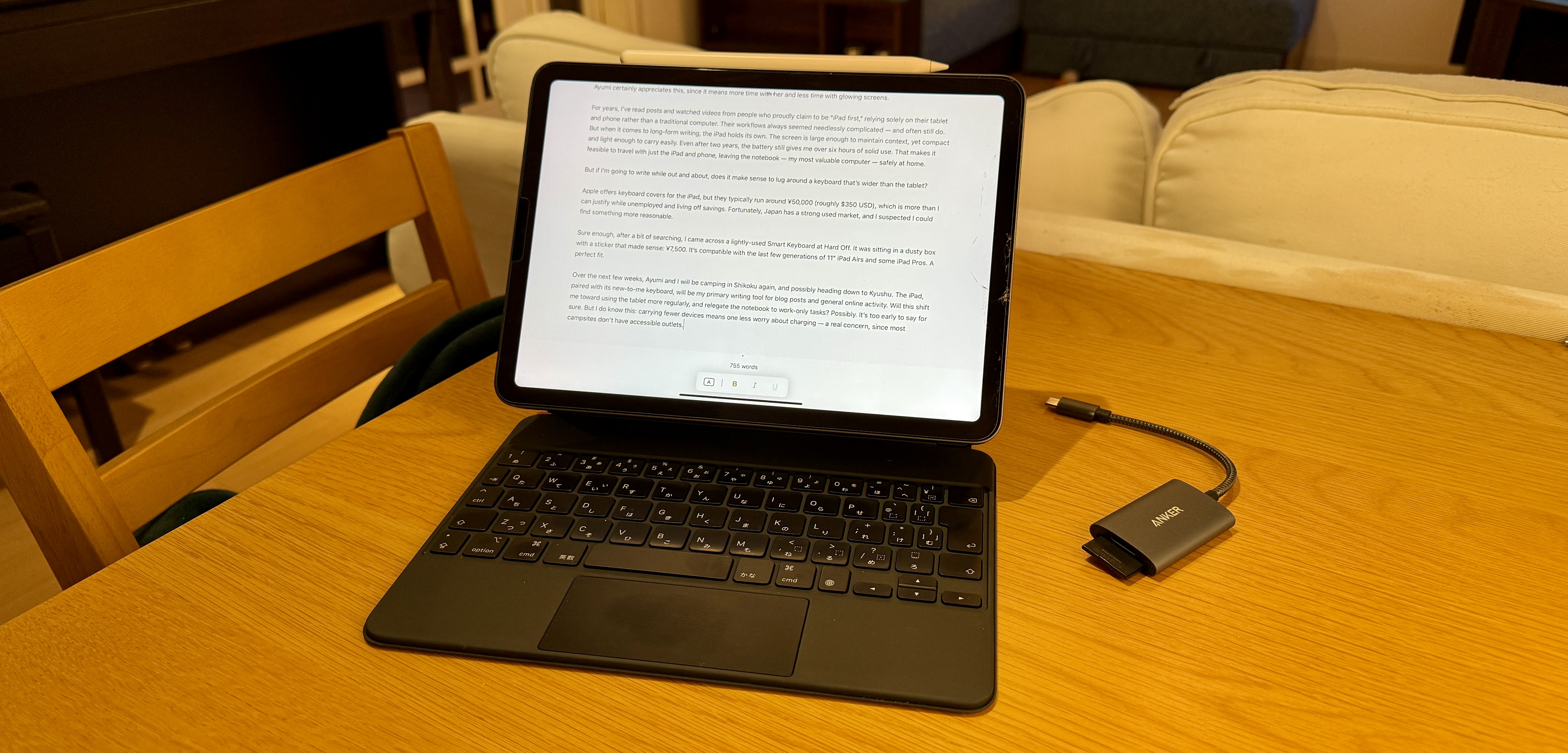
Over the next few weeks, Ayumi and I will be camping in Shikoku again, and possibly heading down to Kyushu. The iPad, paired with its new-to-me keyboard, will be my primary writing tool for blog posts and general online activity. Will this shift me toward using the tablet more regularly, and relegate the notebook to work-only tasks? Possibly. It’s too early to say for sure. But I do know this: carrying fewer devices means one less worry about charging — a real concern, since most campsites don’t have accessible outlets.